Doubt at All Costs
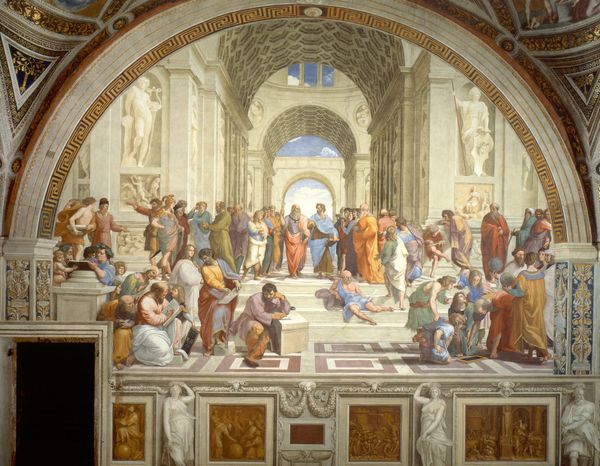
Aristotle puts it simply: truth is about reality. It is not about what sounds persuasive, coherent, or useful. For him, truth appears when thought or speech puts things together properly. It is expressed in a correct judgment about the world. That is good news for archaeologists, historians, journalists, police investigators, fact-checkers, and forensic scientists. The past is not infinitely elastic. Something happened, and that thing is the truth.
“... to say of what is that it is, and of what is not that it is not ...”
But gaining full access to what happened is much harder than it seems. As investigators, we are not handed the truth directly. None of us has it in full. What happened is not directly available to us. We approach it through traces, fragments, texts, images, echoes, smells, digital footprints, datasets, and metadata. We piece these together to reconstruct what happened in our absence. By examining what remains, we infer what we did not witness.
An image may point us to a location at a certain date/time. At that location, we may find fingerprints. From those fingerprints, we may corroborate the identity and the likely activity of the person in the image. Through this exercise, we bring answers: what happened? where? when? and who?
But conclusions like these are not categorical like Aristotelian deduction. They may be well supported, sometimes very strongly, but as David Hume reminds us, the opposite remains logically possible.
“The contrary of every matter of fact is still possible ...”
Where Hume warns us against being too certain, Charles Sanders Peirce offers a practical way of moving closer to the truth: imagine an explanation for what you observe. Ask what event would favour finding these clues. From there, the hypothesis has to be tested, challenged with alternatives, and revised based on what may have appeared as facts.
A hypothesis is something to test, not something to fall in love with.
Duhem and Quine teach us that a good explanation is not the only explanation. The same evidence can support several different stories about what happened. The image may have shown a similar-looking but different place. A fingerprint found in real life is often partial or unclear. The lower its quality, the greater the chance of attributing it to the wrong person. And even if the identification result is correct, the object carrying the print may have been moved to the scene later, misleading us about the person’s presence or actions.
Rather than asking whether their observations fit their imagined scenario, serious investigators ask how the evidence behaves across competing hypotheses. Observations become more valuable when they shift the balance between those alternatives. How well does this evidence fit this explanation, compared with its alternatives?
That is the move from storytelling to inquiry. Once that is understood, probabilistic reasoning follows naturally. Absolute certainty becomes rare (if it was ever there to begin with). This affects the way results should be reported. The conclusion would look more like the following:
It is more probable to observe this fingerprint if this person were present than if someone else were.
That is the basic logic of probabilistic interpretation in forensic science. It is often performed by calculating how much more the findings support one proposition over another... Not by claiming that the findings settle the whole case.
A trace may be rare. A match may be strong. This reinforces the evidential value but does not bring certainty to the conclusion. This way of reporting respects the concept of fallibilism. A conclusion may be justified without being conclusive. We may have strong grounds for an interpretation without being entitled to present it as final.
So “doubt at all costs” is not hesitation, and it is not indecision. It is a way of keeping conclusions proportionate to the evidence, in context.